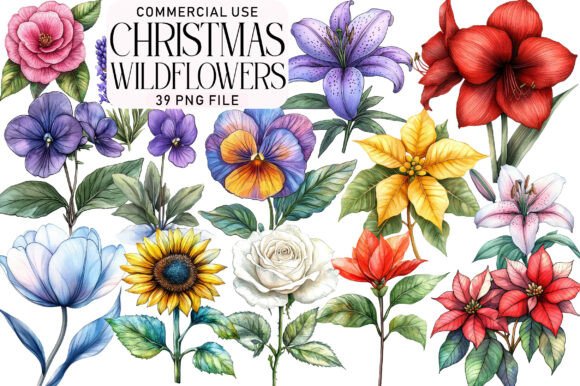
Reviewing Christmas Wildflowers Clipart for Embroidery
As a designer who spends half my life staring at digitized paths and the other half pulling thread through fabric, I have learned to be skeptical of digital assets. We see thousands of design assets flood the market every season, but few hold up when translated from a screen to a needle. Recently, I spent some time evaluating Christmas Wildflowers Clipart, not just as a graphic element, but as a potential foundation for real-world embroidery projects. The goal was simple: determine if this collection of Illustrations could survive the transition into a high-quality handmade product that customers would actually value.
The First Impression: Mood and Visual Personality
The immediate appeal of Christmas Wildflowers Clipart lies in its departure from traditional, rigid holiday motifs. Instead of heavy, blocky snowflakes or standard holly leaves, these designs offer an organic, airy feel. The shapes are fluid, suggesting a whimsical winter garden rather than a stiff seasonal greeting. For an embroidery designer, this is both a blessing and a challenge. The visual personality is soft and inviting, which makes it ideal for personalized gifts where warmth and thoughtfulness are key selling points.
However, the detail level requires careful scrutiny. In digital form, fine lines look crisp. In embroidery, those same lines can become lost if the stitch density is not managed correctly. My initial assessment focused on how the wildflower stems and petals would translate into satin stitch or running stitch elements. The layout suggests a need for precision; there is little room for error in the spacing between elements if you want to maintain the delicate aesthetic.
Real-World Application: From Screen to Stitch
To test the viability of these designs, I imagined a specific scenario: creating a limited run of boutique tote bag design options for a local craft fair. The client wanted something that felt festive but not kitschy. Christmas Wildflowers Clipart fit this brief perfectly. When applied to a natural canvas tote, the organic lines of the wildflowers complemented the texture of the fabric. Unlike dense fill stitch designs that can make lightweight fabric pucker, these lighter, more open compositions allow the material to breathe.
I also considered its use in sweatshirt embroidery. Here, the thicker fabric provides a stable base for slightly more complex detailing. The contrast between the soft, wintery floral themes and the cozy texture of fleece or cotton blend creates a sophisticated look. This is not just a holiday embroidery piece; it is a design that can extend into early spring, giving the finished product a longer shelf life for Etsy sellers and small shop owners. Versatility is crucial for maintaining inventory turnover without constant redesign.
Navigating Fabric and Hoop Constraints
While the aesthetic is strong, practical application demands caution. These designs are not one-size-fits-all. If you are working with a small hoop size, such as a 4x4 inch frame, you must be selective about which elements of the clipart you use. Trying to cram a complex wildflower arrangement into a tiny space will result in a muddy, indistinct patch. It is better to isolate single stems or smaller clusters for caps and hats.
Fabric choice is equally critical. On stretchy fabric like jersey knits used for baby embroidery or t-shirts, the lack of heavy saturation in these designs is an advantage, but only if paired with the right stabilizer. A cut-away stabilizer is often necessary to prevent distortion during washing. Conversely, on dark fabrics, the thin lines of the wildflowers might disappear if the thread colors do not have sufficient contrast. I always recommend testing the design in a black-and-white mockup first to ensure the silhouette remains clear regardless of color choices.
Commercial Viability and Brand Consistency
For craft business owners, the question is always about perceived value. Does Christmas Wildflowers Clipart elevate the brand? Yes, because it signals attention to detail. Customers are increasingly savvy; they can spot a generic, poorly adapted design. Using these nuanced Illustrations suggests a curated approach. Whether you are creating an embroidered patch for a jacket or a delicate accent on a kitchen towel, the uniqueness of the wildflower theme helps your small shop product stand out in a saturated market.
Moreover, these designs work well for printable mockup previews. Because the lines are clean and distinct, they photograph well, allowing you to create compelling digital marketing materials before you even stitch a single thread. This efficiency is vital for digital embroidery file sellers who need to showcase versatility across different custom apparel items.
Practical Designer Notes for Execution
Before committing to a full production run, there are several steps every designer should take when using this type of clipart:
- Test on scrap fabric: Never skip this step. Check how the stitch density interacts with your specific material.
- Check thread contrast: Ensure your chosen thread colors pop against the background, especially for fine details.
- Review stitch types: Determine if parts of the design should be converted to applique design elements to reduce bulk and stitch count.
- Confirm licensing: Always verify if the license allows for commercial embroidery and the sale of finished physical goods.
- Inspect small details: Zoom in on the digital file to ensure there are no stray nodes or overlapping paths that could cause machine errors.
Ultimately, Christmas Wildflowers Clipart is a resource that rewards careful handling. It is not a plug-and-play solution for every project, but for the thoughtful designer, it offers a fresh, elegant alternative to standard holiday fare. By respecting the limitations of the medium and leveraging the strengths of the design, you can create personalized gifts and boutique branding items that resonate with buyers looking for something truly special.